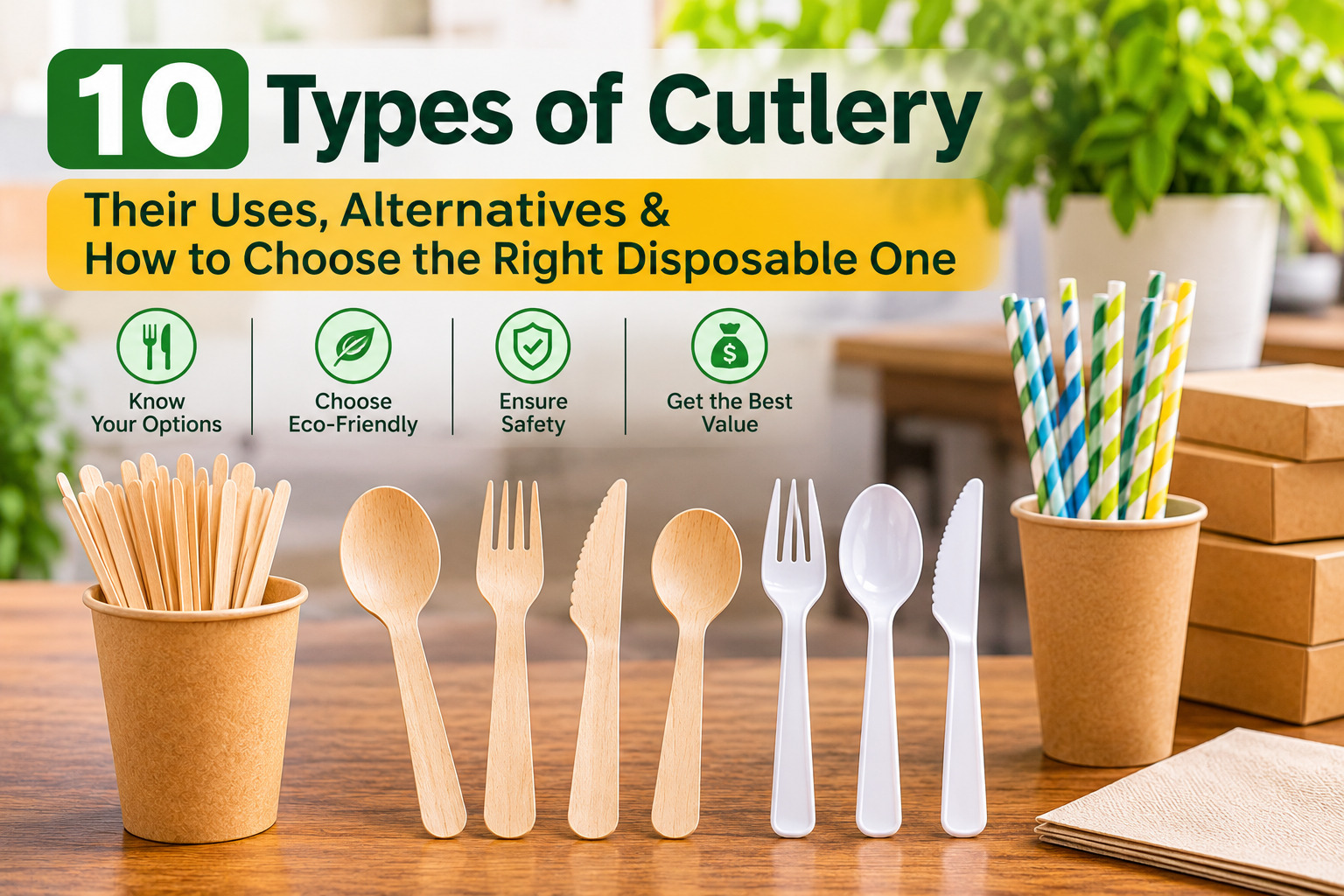
Ten pieces cover most menus: four spoons, two forks, two knives, a serving spoon and a spork.
Plastic cutlery rarely gets recycled. It’s too small for sorting machines and usually has food stuck to it.
For events and takeaway, wooden and bagasse cutlery are the easiest swap I know of.
Choose by your menu and how hot the food is, not just the price per piece.
A lot of people ask me for a simple list of the 10 Types of Cutlery: Their Uses, Alternatives & How to Choose the Right Disposable One. This post is my attempt at writing it down properly. I have worked with caterers, banquet managers and families planning functions in Ahmedabad for years now and the same mistakes keep coming up.
The one I still think about was a wedding where the caterer bought 3,000 spoons and nothing else. The menu had dal, rice, a big kheer counter and a salad bar that hardly anyone touched because there were no forks. People ate kheer with flat teaspoons, the kind meant for chai. The family didn’t say much to the caterer that night but I could see it on their faces.
So before you place a bulk order, it helps to know what each piece is actually for.
Getting Cutlery Uses Right Saves More Than You’d Expect
Most of us don’t think about cutlery until something goes wrong. You write “spoons and forks” on the order sheet, tick it off and move on to the décor. I get it. But this is exactly where money leaks out, one packet at a time.
What usually goes wrong:
- a thin spoon snaps in thick biryani (it happens more often than you’d think)
- forks are too short for noodles so guests give up and use their fingers
- the knives can’t get through a paneer tikka
- whole boxes of pieces nobody needed get thrown out after the event, still sealed
Once you understand cutlery uses for your own menu, you’ll order fewer pieces and waste less. The buffet runs smoother too. Guests won’t compliment you on your spoons. They will notice when the spoon is wrong though.
If you’d like to see how each piece is meant to be held at a formal table, have a look at this video guide by Epicurious on how to use every utensil. It’s about 20 minutes long with over a million views. Food scholar Darra Goldstein walks through why each shape exists and I picked up a couple of things from it myself.
The 10 Types of Cutlery I Plan Every Order Around
This is the list I actually work from when a client calls with a guest count. I’ve grouped it roughly the way food gets served at most Indian functions.
Spoons and Forks You’ll Use at Almost Every Meal
- Dinner spoon (tablespoon)
- Carries out almost all the functions. Rice to dal, sabzi to pulao.
- Teaspoon
- Tea, coffee, chutney and sweets such as rasmalai.
- Soup spoon
- Bigger than a teaspoon in order to eat soup or rasam.
- Dessert spoon
- Between teaspoon and dinner spoon. I always advise my clients to order these spoons for kheer and ice cream.
- Dinner fork
- Four tines. It can be used to eat pasta, noodles, chaat and many more starters.
- Fruit/salad fork
- Little smaller and lighter. Place them on the fruit table.
Knives, Serving Spoons and the Spork
- Table knife
- Serrated edge, which is good enough to cut cutlets, tikka and soft breads.
- Butter knife
- Blunt edged knife that is used for butter or jam in the morning.
- Serving spoon
- Long and big. It stays at the counter and shouldn’t end up on anyone’s plate.
- Spork
- A spoon with little fork tips. For takeaway and food trucks I honestly think it’s the most useful single piece you can buy.
I keep a version of this table saved on my phone. Between them, these 10 types of cutlery have covered pretty much every menu I’ve helped with, from small office lunches to big receptions.
| Cutlery type | Best for | Disposable option that works |
|---|---|---|
| Dinner spoon | Rice, dal, curries | Wooden spoon |
| Teaspoon | Tea, chutney, mithai | Wooden teaspoon |
| Soup spoon | Soups, rasam | Deep wooden spoon |
| Dessert spoon | Kheer, ice cream | Wooden or bagasse spoon |
| Dinner fork | Pasta, noodles, starters | Wooden fork |
| Salad or fruit fork | Fruit, salads | Short wooden fork |
| Table knife | Cutlets, tikka, soft bread | Wooden knife |
| Butter knife | Butter, spreads | Wooden knife |
| Serving spoon | Buffet counters | Large wooden or bagasse spoon |
| Spork | Takeaway, food trucks | Wooden spork |
Is Disposable Cutlery Recyclable?
Restaurant owners ask me this all the time. For plastic the answer is mostly no. It surprised me too the first time I looked into it.
Most plastic forks and spoons are made of polystyrene or polypropylene. Both can technically be recycled. The trouble is the size. They’re so small and light that they slip straight through the sorting machines at recycling plants. Add a bit of leftover curry on each one and most facilities simply won’t take them.
In India the question is mostly settled anyway. Plastic forks, spoons, knives and trays have been banned since July 1, 2022 under the single-use plastic rules. The full list is in the CPCB notice on the single-use plastic ban if you want to check. So for a business today the real question isn’t whether plastic can be recycled. It’s what to use instead.
That’s where wooden and bagasse cutlery come in. They’re made from plant fibre so they break down in compost without needing a recycling plant at all. These days when someone asks me “is disposable cutlery recyclable?” I usually tell them they’re asking the wrong question. Pick something that composts and you don’t have to worry about it.
Plastic Cutlery Alternatives I’d Actually Use
I’ve tried more options than I can remember. Some looked lovely in the catalogue and fell apart the moment they met hot sambar. This is how the main ones compare in my experience:
| Material | Strength | Handles heat | Best use |
|---|---|---|---|
| Birchwood (wooden) | High | Yes | Weddings, cafes, takeaway |
| Bagasse (sugarcane) | Medium to high | Yes | Events, cloud kitchens |
| Paper | Low | Limited | Light snacks only |
| Edible cutlery | Medium | Limited | Novelty, small portions |
| Steel (reusable) | Very high | Yes | Home, in-house dining |
A few things I’d add to that table:
- Wooden cutlery is what I recommend for heavy, hot Indian food. Birchwood doesn’t bend in biryani and leaves no taste behind.
- Bagasse works really well for desserts and lighter meals, especially if you’re already using bagasse plates.
- Paper spoons look nice in photos. In hot curry they go soft within a few minutes.
- Edible spoons are fun at a product launch. For 500 guests, not so much.
If you can wash and reuse, steel is still the greenest option. No argument there. For events, catering and delivery that’s rarely realistic though. Compostable plastic cutlery alternatives like wood and bagasse are the practical middle ground and it’s what most of our clients have moved to.
Choosing Disposable Plates and Cutlery for Your Event
Choosing well has less to do with the catalogue and more to do with what’s on the menu. This is roughly the checklist I go through with clients:
First, look at the menu. If it’s mostly gravy you need strong spoons. Chaat means you need forks. Desserts like kheer need a deeper spoon than people expect. I usually ask clients to write each dish down with the piece it needs next to it. It takes ten minutes and stops most of the over-ordering.
Heat matters more than anyone thinks. I’ve seen spoons go limp in a bowl of hot sambar before the guest even sat down. Wood and bagasse have held up best for me, even with halwa straight off the stove.
Don’t buy plates from one place and spoons from another without checking them together. A solid bagasse plate is no use if the spoon bends on it. I’d order your disposable plates and cutlery as one matched set whenever you can.
Count per guest. At a buffet people come back for dessert, sometimes twice, so I plan around 1.5 to 2 spoons per head.
Find out where the waste is going before you choose. If the venue sends it to a compost unit, almost anything plant based is fine. A municipal bin or a hotel kitchen might deal with it differently.
Pick what will actually break down there.
Get samples first. Try a few pieces with your own food before you place a bulk order.
Mistakes I keep seeing:
- only spoons ordered for a menu that has chaat or pasta
- the cheapest lot bought without anyone testing it on hot food
- no serving spoons at half the buffet counters
One more tip that has saved me more than once: keep about 10% extra stock. Something always runs short on the day and running out of forks halfway through a reception is the sort of thing guests talk about later.
FAQs
- Which cutlery pieces do most hosts actually need?
- For most functions the 10 types of cutlery you’ll need are the dinner spoon, teaspoon, soup spoon, dessert spoon, dinner fork, salad fork, table knife, butter knife, serving spoon and spork. Smaller menus can skip a few.
- Can wooden cutlery be used for hot food?
- Yes. Good birchwood cutlery handles hot curry, rice and soup without bending. It won’t change the taste either.
- How many spoons should I order per guest?
- I usually plan 1.5 to 2 spoons per guest for a buffet. Add forks only if there’s pasta, chaat or salad on the menu.
- Is bagasse cutlery strong enough for events?
- For most menus, yes. It’s good for desserts, snacks and medium-weight meals. For very heavy gravies I’d still go with wood.
- How do I dispose of wooden or bagasse cutlery?
- Put it in wet or organic waste. Both are plant based and break down in compost.
- Are plastic spoons still allowed in India?
- No. Plastic forks, spoons and knives have been on India’s single-use plastic ban list since July 2022.
Final Thoughts
Cutlery feels like a small line on the order sheet. It still decides how comfortably your guests eat and how much you throw away afterwards. Once you know the 10 types of cutlery and what each one is for, ordering gets a lot simpler. You buy what the menu needs and leave out what it doesn’t.
If you are moving away from plastic, wooden and bagasse cutlery are a good place to start. At Anirudh Agro Industries we make eco-friendly wooden cutlery and bagasse products here in Ahmedabad for caterers, restaurants and event planners. Ask us for a few samples, try them with your own food and then decide.