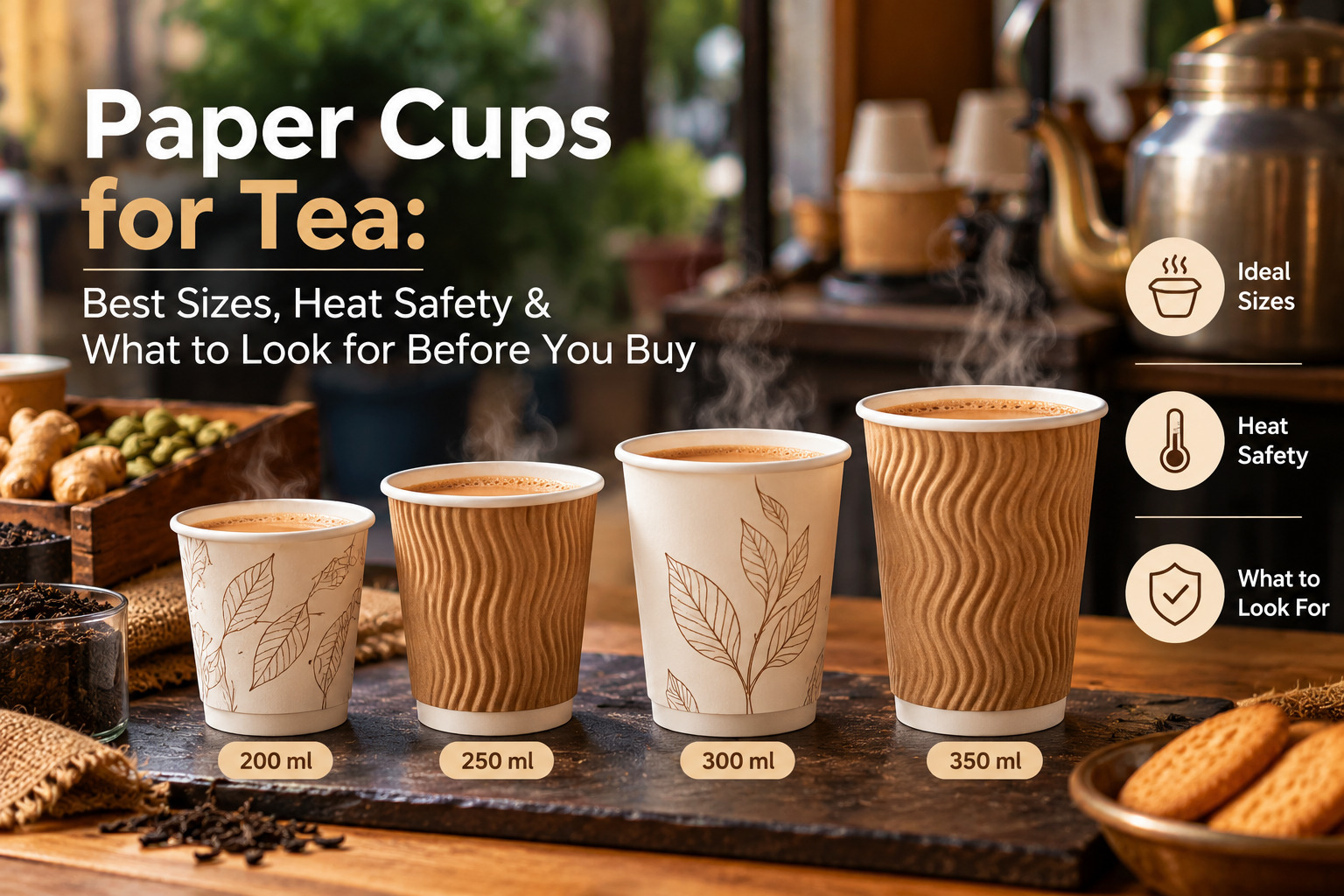
- Serving cutting chai? Go for 55 to 65 ml. A proper office cup of tea sits better in 85 to 130 ml.
- Chai normally falls somewhere between 70°C and 90°C when poured into the cup. Thin board cannot withstand such temperatures.
- A study by IIT Kharagpur reveals plastic particles leaching out of cup linings when hot water sits in them for 15 minutes. Have it fresh.
- Ask your supplier for the GSM, coating type, and food grade reports in writing. Then pour boiling water into a sample and wait around ten minutes.
This guide answers your questions step by step. There’s also a quick checklist near the end for your next bulk order.
Written by the AAI team. Last checked in October 2026. Health and regulation points link back to where they came from.
What Tea Cup Size Do You Actually Need?
Well, it depends on who is consuming it and the rate at which they consume it. The needs of a commuter who wants to enjoy a quick cutting chai on a train platform are different from those of an office worker who wants tea during a long meeting.
Get the tea cup size wrong and you lose either way. Too small and people keep asking for refills. Too big and you’re paying for paper nobody fills.
| Cup Size | What It’s For | Where It Works |
|---|---|---|
| 55 to 65 ml | Cutting chai, tasting counters | Tea stalls, railway vendors, quick refill events |
| 80 to 90 ml | A standard small tea | Offices, factories, hospital wards |
| 100 to 130 ml | A full cup of tea or coffee | Corporate pantries, meetings, cafés |
| 150 to 200 ml | Masala tea, coffee, soup | Cafés, caterers, takeaway counters |
| 250 to 300 ml | Large hot or cold drinks | Cafés and quick service outlets |
Our tea range goes from 55 ml cutting chai cups up to 130 ml. That covers most of how India drinks its tea.
A few small things nobody tells you:
- Avoid overfilling. A hot tea at the edge is difficult to hold and spills when someone moves.
- Check the volume your dispenser actually serves. A 100 ml dispenser will leave little room in a 90 ml cup.
- Bigger isn’t kinder. A half full cup of tea cools down quicker than a full one.
Is It Safe to Drink Hot Tea From a Paper Cup?
Short answer? Yes, if the cup is food grade and the tea doesn’t sit in it forever.
Chai comes off the stove hot. By the time it’s poured it’s usually somewhere between 70°C and 90°C. Heat affects two key areas of the cup.
- The board. Thin paperboard soaks up heat and moisture. Then it starts to sag. You’ve felt that wobble in your hand.
- The lining. Plain paper would leak in seconds. That’s why there’s a thin plastic or plant based layer inside. This layer takes the most stress.
Back in 2020, Dr Sudha Goel and her team at IIT Kharagpur poured water at 85°C to 90°C into disposable paper cups. They left it for 15 minutes. When they checked, every 100 ml held roughly 25,000 microplastic particles. For a closer look at the research, refer to the study summary available on IIT Kharagpur’s official website.
Now the fine print. They used pure lab water, not chai. Nobody has proven a direct health effect yet. The researchers themselves say long-term risks still aren’t clear.
Our take is simple:
- Drink your tea while it’s fresh.
- Don’t reheat tea in a paper cup. Never microwave one.
- Buy from makers who can hand you food grade test reports.
Paper Cup Coating: The Part You Can’t See
The paper cup coating is that thin film on the inside. This is why your tea stays in the cup rather than soaking into the board. The material also determines what happens to the cup after it’s thrown away.
| Coating | With Hot Tea | After Use | Worth Knowing |
|---|---|---|---|
| PE (polyethylene) | Works well | Needs a recycler that takes lined paper | Most common and cheapest |
| PLA (plant-based) | Usually fine — check the rated temperature | Composts only in industrial facilities | Costs more than PE |
| Water-based barrier | Depends on the product — ask for test data | Built to be easier to recycle | Newer; supply is growing |
| Wax | Not suitable | Hard to recycle | Melts with hot drinks — avoid for tea |
On a typical PE tea cup the plastic layer is small often around 15 GSM, sitting on board that weighs roughly ten times more. So yes, it’s mostly paper. That thin film is still the reason recycling gets complicated.
The rules are shifting too. In November 2024 the Bureau of Indian Standards put out a draft standard for paper that touches food. It nudges makers towards bio based and water based coatings and caps what’s allowed to migrate into food. Check where it stands today before printing any compliance claim on your cups.
Single Wall, Double Wall or Ripple: Which One for Hot Tea?
Think about how long the cup stays in someone’s hand.
- Single wall. One layer of board. Perfect for cutting chai that’s gone in two sips.
- Double wall. A second outer layer with air trapped in between. People can hold a full cup without a sleeve.
- Ripple wall. That ridged outer layer you’ve seen at cafés. Better grip, more insulation, and a slightly premium look.
Do your customers walk around with their tea or sip slowly through meetings? Then ripple or double wall hot paper cups earn back the small extra cost. Fewer burnt fingers. Fewer dropped cups.
What Should You Check Before a Bulk Order?
The rate per thousand is one line on the quote. Here’s what else to ask:
- Size. Does it match your real serving with a bit of space left at the top?
- Board GSM. Small tea cups usually run on lighter board. Bigger hot cups need heavier stock. Get the number in writing.
- Coating. PE if price matters most. PLA or water based if you’re making green claims.
- Food grade proof. Ask for the test reports. A “don’t worry, it’s food grade” on the phone isn’t proof.
- Bottom seal. Most leaks start right there. Check a sample closely.
- Packing. How many cups per sleeve and per carton? Keep cartons dry and off the floor.
Then do the ten minute test. Fill a sample with freshly boiled water. Wait ten minutes. Give it a gentle squeeze and check the base and the seam. A good cup stays firm and the outside stays dry.
Are Paper Tea Cups Really Eco-Friendly?
Good move asking. But paper is not always green. Beyond the material, check the inner coating, recyclability, and disposal. An eco friendly disposable glasses are a more responsible choice only if its materials and end-of-life handling support that claim.
- PE lined cups are mostly paper. They still need a recycler that handles lined board.
- PLA lined cups compost only in industrial facilities. Your garden pit won’t do it.
- Printing “biodegradable” on a PE lined cup isn’t accurate. Skip it.
Want a genuinely greener counter? Look for cups with PLA or water-based coatings from suppliers who can back the claim with documentation.
Frequently Asked Questions
What is the right size paper cup for tea?
It depends on the purpose. For cutting chai, 55–65 ml is right. For office use, 85–100 ml fits well. To serve a full cup of tea or coffee, choose 130 ml or more.
Can you pour boiling tea straight into a paper cup?
Food grade cups are made for it. Still, give the tea a few seconds off the boil. Leave space at the top and pick a double or ripple wall cup for bigger servings.
Which coating works best for tea cups?
PE is the most common and handles hot tea well. PLA or water-based suits brands that care about their environmental footprint. Whatever you pick, ask for the rated temperature in writing.
Why does my paper cup go soft or leak?
Usually the board is too thin for that size. Sometimes the bottom seal is weak. Heavier board and a properly sealed base fix most of it.
Final Word
A good tea cup should not get noticed at all. It holds the right amount, stays firm while the chai is hot, and leaves nobody guessing about what’s inside.
Not sure which one suits your counter? Browse our tea cup range or call the AAI team for samples and bulk rates.